What is the difference between planning and goal setting?
Planning vs goal setting explained — how they differ, why you need both, and how to combine them to actually achieve your goals.
Enjoying this article?
Get more like it every week — methods, tools, and lessons from building in Cambodia.
No spam. Unsubscribe anytime.
Goal setting decides what you want to achieve; planning decides how you'll get there. Goal setting is strategic — it defines the specific, measurable outcome you're aiming for. Planning is tactical — it turns that outcome into a sequence of actions, deadlines, and resources. You need both: a goal without a plan is a wish, and a plan without a goal is busywork.
Here's the difference at a glance:
| Goal setting | Planning | |
|---|---|---|
| Answers | What do I want to achieve? | How will I achieve it? |
| Nature | Strategic, visionary | Tactical, operational |
| Output | A clear, measurable target | A step-by-step roadmap |
| Timeframe | Often longer-term | Continuous, shorter cycles |
| Changes | Relatively fixed once set | Adjusted as circumstances shift |
Below, we break down each process, the seven key differences, and how to combine them with OKRs so your goals actually get done.
Understanding Planning
Planning is the process of determining how you will achieve your goals. It involves identifying the desired outcomes, analyzing the current situation, determining what actions must be taken, and then creating a roadmap to guide the steps required to achieve the desired results.
It can be done at different levels, from individual to organizational. It can cover a range of timeframes, from short-term (day-to-day) to more long-term vision. Effective planning requires anticipating potential challenges, allocating resources, and adjusting plans as needed.
The Importance of Effective Planning
Planning is crucial because it helps you to:
- Visualize and clarify what you want to achieve
- Break down complex tasks into smaller, more manageable parts
- Anticipate and prepare for potential challenges
- Optimize your time and resources
- Stay accountable and focused on your priorities
Understanding Goal Setting
Goal setting defines specific, measurable, achievable, relevant, and time-bound objectives an individual or organization wants to achieve (SMART goals). We can set short-term goals or long-term goals, personal or business goals. It involves setting challenging but realistic targets and then identifying the steps required to achieve them. It is a critical component of any successful personal or business strategy.
Goal setting provides a clear focus and direction. It helps you prioritize your efforts and resources toward achieving your desired outcome. Setting goals aligned with the organization's or individual's overall vision and mission is essential.
To achieve success, it is essential to follow a structured approach. This includes identifying and prioritizing goals, breaking them down into smaller, more manageable steps, assigning accountability for each step, and tracking progress toward achieving each goal.
To achieve that, weirdo.rocks team uses and recommends OKRs (Objectives and Key Results). They help us to stay on our path toward the goal and track our progress. OKR system also ensures that everyone involved is working towards the same measurable objectives.
The Importance of Successful Goal Setting
Goal setting is crucial because it helps you to:
- Clarify and define what you want to achieve
- Create a sense of purpose and direction
- Increase motivation and commitment
- Measure progress and track results
- Celebrate successes and learn from failures
What is the Difference Between Planning and Goal Setting
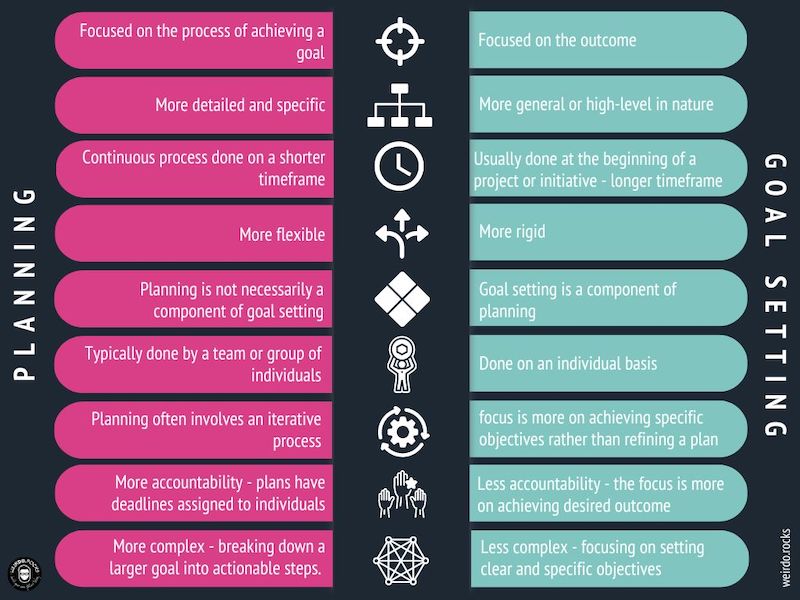
While planning and goal setting are indeed complementary processes, they are fundamentally different in several ways:
🎯 Focus
- Planning focuses on achieving a goal, while goal setting focuses on the outcome or desired result. Planning is more tactical and operational, while goal-setting is more strategic and visionary.
🔗 Structure
- The planning process is generally more detailed and specific than goal setting. It involves breaking down the steps to achieve a goal into smaller, actionable tasks.
- Goal setting, on the other hand, can be more general or high-level, focusing on overall objectives rather than specific steps.
🕑 Timing
- Planning is a continuous process that happens throughout the execution of your goal. In contrast, goal setting is typically done at the beginning of a project or initiative. Planning involves ongoing adjustments and adaptations to ensure you are on track to achieve your goal.
- Planning is typically done on a shorter timeframe, such as weekly, monthly, or yearly, while goal setting may involve setting objectives over a more extended period, such as several years.
🙆🏻 Flexibility
- Planning can be more flexible than goal setting, as plans can be adjusted and adapted as circumstances change.
- Goal setting, on the other hand, is generally more rigid, as specific objectives are set and may be difficult to change once established.
🧩 Components
- Goal setting is a component of planning, as setting specific objectives is necessary for effective planning.
- However, planning is not necessarily a component of goal setting, as it is possible to set goals without a particular plan to achieve them.
🗝️ Ownership
- Planning is typically done by a team or group of individuals, while goal setting by an individual basis.
- While both planning and goal setting requires input and participation from stakeholders, planning may involve a larger group of individuals working together to achieve a common objective.
🔄 Iteration
- Planning often involves an iterative process, reviewing and refining plans over time.
- Goal setting may also involve iteration but focus more on achieving specific objectives than refining a plan.
🤝 Accountability
- Planning may involve more accountability than goal setting, as plans often have specific deadlines and responsibilities assigned to individuals or teams.
- Goal setting may involve a different level of accountability, as the focus is more on achieving the desired outcome than meeting specific deadlines or milestones.
🎛️ Complexity
- Planning is typically more complex than goal setting, as it involves breaking down a larger goal into smaller, actionable steps.
- Goal setting may be more straightforward, setting clear and specific objectives to achieve a desired outcome.
Why OKRs Are a Great Way to Combine Planning and Goal Setting
OKRs are a super effective way to set goals and plan for success. This method brings together the best of both worlds. It helps you achieve specific, measurable goals to progress toward your result.
When you use OKRs, you focus on the outcome, not the process. This means you're working towards the same objectives and have a clear direction to follow. It doesn't matter if you're working as a team or by yourself; OKRs help you grow, stay on track, and eliminate unnecessary fluff.
With OKRs, you're responsible for achieving your objectives and making progress toward your goals. You're accountable for your progress, making you more likely to succeed.
The best part about OKRs is that they're flexible so that you can respond to changes in the market or your circumstances. You don't have to follow a strict plan, but you can adjust your approach to get the desired results.
Regular check-ins and reviews are crucial to OKRs, as they allow you to learn from your mistakes and successes. This means you can make adjustments and keep making progress toward your goals.
Connecting planning and goal setting with OKRs is a practical and effective way to achieve your goals, whether they're personal or professional. OKRs provide a clear, concise framework that promotes alignment, accountability, and continuous improvement.
☝️ If you want to learn more about planning, achieving your goals, and securing future success with the help of OKRs weirdo.rocks team has you covered!
We created a free email course to give you practical knowledge and everything you need to know, from assessing your current situation to defining your goals and the measurable steps to achieve them with a structured process.
⬇️ ⬇️ Enroll here and start setting goals you'll actually reach ⬇️ ⬇️
Set, Track, and Achieve Any Goal with OKRs
Frequently Asked Questions
Is goal setting part of planning, or the other way around?
Goal setting comes first and sits inside the wider planning process. You set the goal (the destination), then you plan the route. You can set a goal without a plan, but you can't build a meaningful plan without first knowing the goal it serves.
Should I set goals or make a plan first?
Set the goal first. Until you know the specific, measurable outcome you want, any plan is aimed at nothing. Once the goal is clear, planning breaks it into the tasks, deadlines, and resources needed to reach it.
What's an example of planning vs goal setting?
"Run a half-marathon in under two hours by October" is a goal — specific, measurable, time-bound. "Run three times a week, add one kilometre every fortnight, and do a long run each Sunday" is the plan — the concrete actions that get you there.
How do OKRs combine planning and goal setting?
OKRs pair an Objective (the goal — what you want) with Key Results (measurable milestones that prove progress). The objective is your goal setting; the key results and regular check-ins are your plan. That's why OKRs work for both individuals and teams.
Once your goals are clear, use OKRs to hit them and understand short- vs long-term goals. See the full Goal-Setting & OKR hub.
Part of
Goal-Setting & OKR Hub
Related Course
Goal Setting with OKRs
The goal-setting system used by Google — adapted for solopreneurs
Take the course →More Self-Improvement

What skills do I need to become a digital nomad?
Discover the top skills you need to become a successful digital nomad! Our guide reveals the secrets to earning a living while exploring the world. Don't miss out!
Maximizing Your Remote Work Efficiency: Productivity Tips for Digital Nomads
Boost your productivity with these simple tips. Meet your goals, become more free and satisfied with yourself. 5 tips that will help you to bring better structure to your digital nomad life
Accountability Partner: How to set, track and achieve Goals with Objectives and Key Results (OKRs)
Setting goals and tracking progress with the help of accountability partner is one of the most powerful ways to reach success. Join and build your future today!